Notice: Test mode is enabled. While in test mode no live donations are processed.
Greater Houston Disaster Alliance hosted a powerful day-long convening that brought together nonprofit leaders, local government officials, and funders with one shared goal: to deepen relationships and enhance our region’s ability to respond rapidly and effectively when disaster strikes.
The significance of our nonprofit ecosystem in our community cannot be overstated. These organizations play a vital role in addressing the diverse needs of our residents, especially during times of crisis. Their commitment to service fosters resilience and strengthens our community’s fabric by ensuring everyone has access to the support they need.
Through a close partnership with the Disaster Alliance, nonprofit organizations provided over 4,100 households access to financial assistance and other critical resources to help them recover from back-to-back disasters in 2024, repairing more than 360 homes.
Behind these numbers are real stories: people able to recover lost wages, parents able to replace the food they lost from fridges and freezers, seniors with secure roofs overhead, and families able to remain in their homes. This impact directly results from the commitment, adaptability, and trusted community ties of the nonprofits in the room.
The Disaster Alliance began this convening with the aim of enhancing its strategy by promoting greater clarity, transparency, and alignment. This convening, built off critical input provided by nonprofits, picked up where the Disaster Alliance left off last November, focusing on working sessions to refine two of the Disaster Alliance’s primary recovery programs: home repair and emergency financial assistance. Together, this group is helping to design a response system that is faster, smarter, and rooted in the lived experiences of the people these nonprofits serve.
Keep reading to discover key takeaways from each part of the day and understand how shared conversations, connections, and strategies are already shaping a more prepared and resilient region. The work doesn’t end in the room; it is helping prime a disaster response system ready to meet our community’s needs when it matters the most.
With over 35 years of combined experience leading disaster recovery efforts, Greater Houston Community Foundation and United Way of Greater Houston formed the Disaster Alliance in 2023 to ensure the region has the networks and systems in place to accelerate recovery effectively in times of disaster. Through an initial investment from Enbridge and Phillips 66, the Disaster Alliance catalyzes public and private partnerships and brings year-round focus to disaster preparedness and resiliency to reduce the harms caused by disaster on our most vulnerable residents.
With just two years under its belt, the Disaster Alliance has made significant strides in transforming how disaster recovery happens in Greater Houston. Some of its key achievements include:
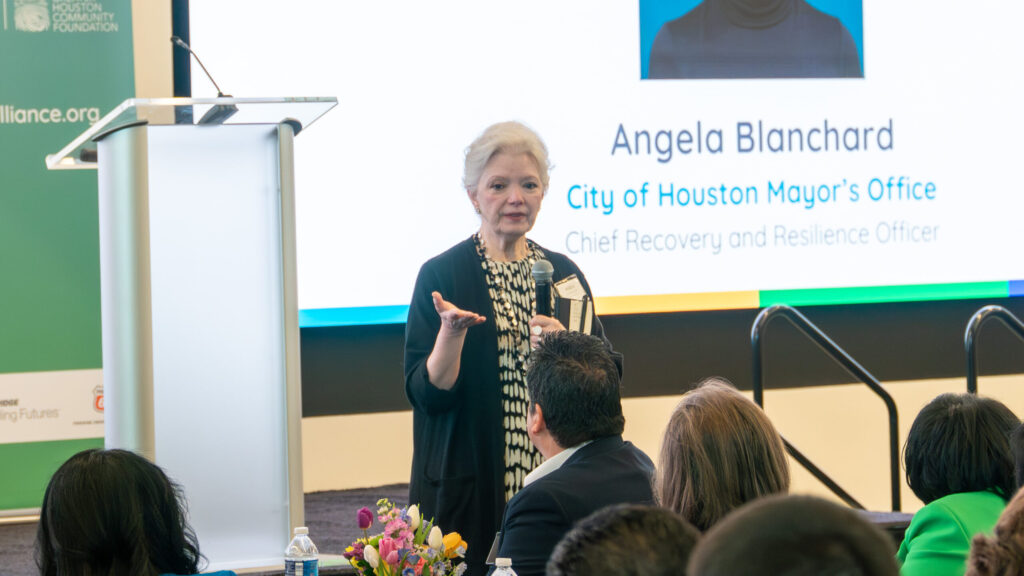
Angela Blanchard, the City of Houston’s Chief Recovery and Resilience Officer, leads efforts to update and integrate the city’s climate action, disaster preparedness, and long-term resilience strategies. Her work and wisdom across topics like community transformation, welcoming immigrants and refugees, nonprofit leadership, and disaster recovery have been featured in numerous publications, including the New York Times, The Atlantic, and the Federal Resource book “What Works in American Communities.” Throughout her 40-year career, Angela has received several awards and recognitions, including the prestigious Heinz Prize for Improving the Human Condition.
Whether working with the White House or on the banks of Houston’s bayous, Angela’s unwavering commitment to helping others allows her to offer this group profound insights into effectively deploying resources in the wake of disasters.
Angela expressed how Houston’s mindset needs to shift from “we shall overcome” to “we shall prepare,” highlighting the importance of taking a 360-degree approach to disaster preparedness, 365 days of the year. The disasters that strike the Houston region are no longer just during the hurricane season—it can happen at any time, as made evident during Winter Storm Uri in 2021 and the Derecho winds in May of 2024.
She also shared that Houston has historically not addressed how heat should be a primary area of focus. Angela referenced a book called “The Heat Will Kill You First,” which highlights how the impacts of heat can become deadly, fast. Angela expressed her concerns, noting that she has been involved in two similar discussions, in 2008 during Hurricane Ike and more recently in 2024 with Hurricane Beryl. She observed that the topics surrounding the maintenance of water and sanitation services have remained consistent over the years. Angela shared that “Houston is an essential city on the Gulf Coast, with an essential port and medical center. Houston is an integral part of global energy. We [Houston] cannot go down, we must be operable come hell, wind, or high water.”
Angela identified two major gaps in Houston’s disaster response. The Houston region does not currently have resilient places of refuge in each community that are operable. Resiliency hubs must have reliable power and backup plans to remain operable. In addition, Angela identified a significant gap in the data transfer process between first responders, including our fire and police departments, and the critical support provided by nonprofits during the recovery phase. Improving this handoff is essential for ensuring a seamless transition in service delivery and enhancing overall community resilience. Angela revealed that the City’s top priority is ensuring that every day, “routine” things, like turning on water, flushing the toilet, or switching on a light, are accessible in the aftermath of a disaster.
Angela offered a valuable insight from her experiences in disaster situations: it’s crucial to recognize that we may need to depend on our own resources and abilities. She prompted the room of nonprofit leaders in the disaster arena to assume that no one bigger and better will be able to solve the causes they are working to address. She encouraged everyone to adopt the mindset of “What will it take for you to stand up for the recovery we want, even if no one comes,” highlighting that resources often come after we need them.
Angela closed by saying, “We do good work because we do good, not because you are promised results or guaranteed an outcome. What matters is the difference you make in the lives of others and the fact that they know someone cares during the toughest moments in life.”
As one of the primary programs for the Disaster Alliance, emergency financial assistance (EFA) plays a key role in accelerating recovery for disaster survivors. EFA provides up to $1,500 paid directly to impacted households to help with recovery expenses from replacing lost wages and food, to costs for temporary housing and home repairs.
The working session was co-facilitated by Connective and the Disaster Alliance and included more than 30 disaster program leaders who provided critical input to improve the way our community delivers EFA in response to future disasters. During the Hurricane Beryl Recovery Fund in 2024, the Disaster Alliance piloted a coordinated intake process for EFA that helped reduce duplication and supported grantees with centralized, quantitative reporting. As a result, grantees reached consensus that coordinated EFA would be a benefit, meaning a common application with centralized intake, eligibility, and reporting.
A coordinated EFA approach relieves some of the administrative burden from nonprofits, allowing them to focus on what they do best: serving disaster survivors. It also has the potential to expand the Disaster Alliance’s reach by reducing duplication and offering an access point for some vulnerable households who may not already be connected with an organization. Due to the scale of disaster and smaller funds, the Disaster Alliance may not always have the resources to invest in a fully coordinated system. With that understanding, nonprofit leaders reached consensus on these initial points:
More than a dozen local home repair agencies gathered for a design session, also co-facilitated by the Disaster Alliance and Connective, to refine the Home Repair Acceleration Program (HRAP) with a focus on establishing reasonable timelines, clarifying the scope of services, estimating costs, and strengthening coordination with long-term recovery efforts.
During Beryl and due to the compounding nature of disaster in 2024, the Disaster Alliance worked with Connective and home repair agencies to design this HRAP that would provide rapid access to home repair acceleration services like roof tarping and debris removal that could mitigate compounding impacts of disaster and streamline the process into traditional home repair programs. At the working session, participants offered the following input:
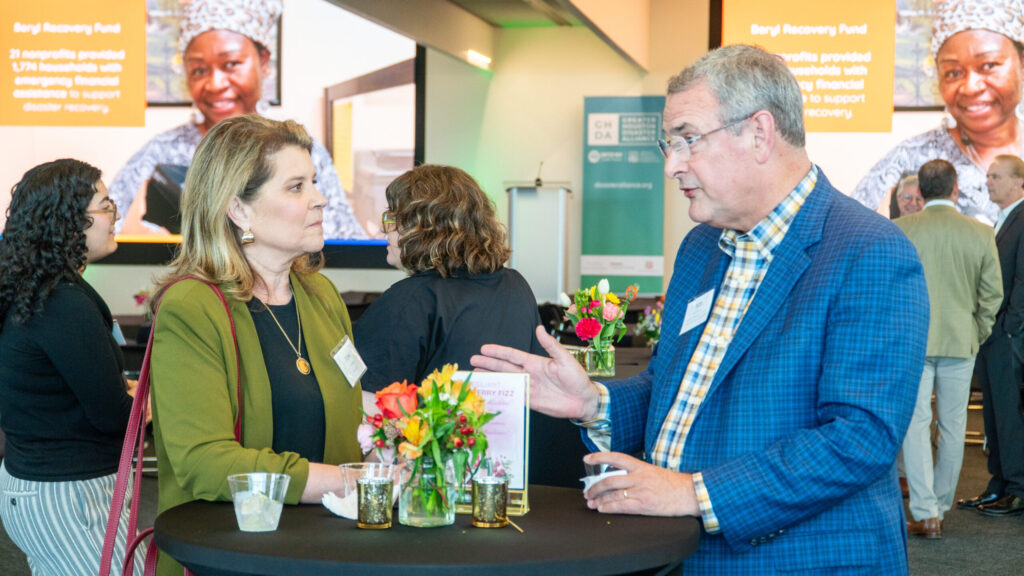
Towards the end of the day, the Disaster Alliance hosted a reception to celebrate how it has evolved into a model of efficiency, collaboration, and innovation in disaster recovery philanthropy. Attendees heard remarks from Donna Sims Wilson, Disaster Recovery Council Co-Chair, Bob Harvey, Disaster Recovery Co-Chair, Amanda McMillian, CEO of United Way of Greater Houston, and Steve Maislin, President and CEO of Greater Houston Community Foundation. The reception was a time to acknowledge that our region can recover faster and better when we work together!
This convening was more than just a gathering—it was a catalyst. By bringing together nonprofit leaders, local government officials, and funders under one roof, the Disaster Alliance took a meaningful step toward building a disaster response system that is faster, more coordinated, and rooted in accessibility.
Looking ahead, the Disaster Alliance is focused and committed to:
The momentum from this day is a starting point for deeper collaboration, smarter systems, and a more prepared region—one that will be ready to meet the moment, no matter what comes next. Support the Disaster Alliance today to help build a more resilient future for our region. To learn more about how to support, please contact info@disasteralliance.org.

Stay Informed. Stay Prepared. Stay Connected!
Sign Up for the Greater Houston Disaster Alliance Newsletter